Singapore POST

25th Anniversary of Port of Singapore Authority

Issue date 03 Apr 1989

Overview

On 1st April 1964, the Port of Singapore Authority (PSA) was formed to replace the former Singapore Harbour Board. The PSA, a statutory board under the Ministry of Communications and Information, is responsible for providing and maintaining efficient and adequate port services and facilities in Singapore. It is also responsible for controlling navigation and traffic in the port as well as promoting the use and development of the Port.

During the Singapore Harbour Board's administration, port facilities in Singapore were confined to some five kilometres of wharves at Keppel Harbour and Telok Ayer. With the development of Jurong into an industrial estate in the 1960s, Jurong Port came into operation as a bulk port in 1965.

Further expansion took place in 1971, when Sembawang Wharves was established at the former British Naval Base. The most significant development was the opening of the Tanjong Pagar (East Lagoon)

Container Terminal on 23rd Jun 1972. Singapore became the first port in Southeast Asia to handle a third-generation container vessel, making Singapore a vital link in the new global chain of container ports. Tanjong Pagar Terminal is now a 100-hectare highly-computerised complex with 11 berths, and is served by a large fleet of various state-of-the-art container handling equipment.

Pasir Panjang Wharves, the “total” gateway providing cargo handling facilities and Southeast Asia's largest warehousing complex, was commissioned in 1974 to promote Singapore as the Central Distribution Centre for the Asia Pacific region.

With this tremendous growth in the last 25 years, the Port has become the world’s busiest in terms of shipping tonnage. Singapore was voted the Best Seaport in Asia by the 1988 and 1989 Asian Freight Industry Awards. It is also the world’s 4th largest container port, the 3rd largest oil refining centre, the top bunkering port in the world and a leading ship repairing and ship building centre.

The Port of Singapore operates round-the-clock every day of the year handling more than 30,000 vessels from 700 shipping lines annually. On any single day, about 600 ships flying the flags of almost all the maritime nations, are in the port.

The PSA's corporate mission is to excel as a global hub and to make Singapore a premier maritime centre. To achieve these goals, the PSA is investing in new facilities such as a new container terminal on Pulau Brani, a large warehousing complex at Nelson Road, advanced computerised and automation systems, modern cargo handling equipment and in the systematic training of its staff.

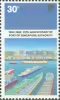
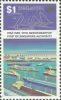
Thi set of stamps features the world’s busiest port supported by Singapore's well-developed infrastructure, and the colour scheme reflects PSA’s round-the-clock operations.
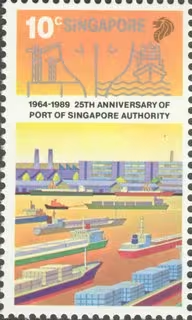
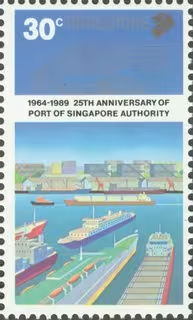
25th Anniversary of Port of Singapore Authority
Technical specifications
Denomination10¢, 35¢, 75¢, $1
Stamp Size26mm x 43.5mm
Perforation13¾ x 13¼
PrintingLithography
Sheet Content50 stamps per sheet
PrinterSecura Singapore Pte Ltd
Graphic DesignerNg Keng Seng
Singapore POST
Singapore POST
Singapore POST
Singapore POST

25th Anniversary of Port of Singapore Authority

Issue date 03 Apr 1989

On 1st April 1964, the Port of Singapore Authority (PSA) was formed to replace the former Singapore Harbour Board. The PSA, a statutory board under the Ministry of Communications and Information, is responsible for providing and maintaining efficient and adequate port services and facilities in Singapore. It is also responsible for controlling navigation and traffic in the port as well as promoting the use and development of the Port.

During the Singapore Harbour Board's administration, port facilities in Singapore were confined to some five kilometres of wharves at Keppel Harbour and Telok Ayer. With the development of Jurong into an industrial estate in the 1960s, Jurong Port came into operation as a bulk port in 1965.

Further expansion took place in 1971, when Sembawang Wharves was established at the former British Naval Base. The most significant development was the opening of the Tanjong Pagar (East Lagoon)

Container Terminal on 23rd Jun 1972. Singapore became the first port in Southeast Asia to handle a third-generation container vessel, making Singapore a vital link in the new global chain of container ports. Tanjong Pagar Terminal is now a 100-hectare highly-computerised complex with 11 berths, and is served by a large fleet of various state-of-the-art container handling equipment.

Pasir Panjang Wharves, the “total” gateway providing cargo handling facilities and Southeast Asia's largest warehousing complex, was commissioned in 1974 to promote Singapore as the Central Distribution Centre for the Asia Pacific region.

With this tremendous growth in the last 25 years, the Port has become the world’s busiest in terms of shipping tonnage. Singapore was voted the Best Seaport in Asia by the 1988 and 1989 Asian Freight Industry Awards. It is also the world’s 4th largest container port, the 3rd largest oil refining centre, the top bunkering port in the world and a leading ship repairing and ship building centre.

The Port of Singapore operates round-the-clock every day of the year handling more than 30,000 vessels from 700 shipping lines annually. On any single day, about 600 ships flying the flags of almost all the maritime nations, are in the port.

The PSA's corporate mission is to excel as a global hub and to make Singapore a premier maritime centre. To achieve these goals, the PSA is investing in new facilities such as a new container terminal on Pulau Brani, a large warehousing complex at Nelson Road, advanced computerised and automation systems, modern cargo handling equipment and in the systematic training of its staff.

Thi set of stamps features the world’s busiest port supported by Singapore's well-developed infrastructure, and the colour scheme reflects PSA’s round-the-clock operations.
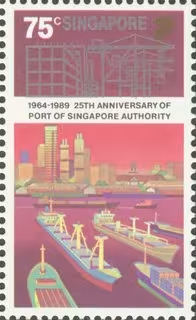
Denomination

10¢, 35¢, 75¢, $1

Stamp Size

26mm x 43.5mm

Perforation

13¾ x 13¼

Printing

Lithography

Sheet Content

50 stamps per sheet

Printer

Secura Singapore Pte Ltd

Graphic Designer

Ng Keng Seng

25th Anniversary of Port of Singapore Authority

Issue date 03 Apr 1989

25th Anniversary of Port of Singapore Authority25th Anniversary of Port of Singapore Authority25th Anniversary of Port of Singapore Authority25th Anniversary of Port of Singapore Authority

Overview

On 1st April 1964, the Port of Singapore Authority (PSA) was formed to replace the former Singapore Harbour Board. The PSA, a statutory board under the Ministry of Communications and Information, is responsible for providing and maintaining efficient and adequate port services and facilities in Singapore. It is also responsible for controlling navigation and traffic in the port as well as promoting the use and development of the Port.

During the Singapore Harbour Board's administration, port facilities in Singapore were confined to some five kilometres of wharves at Keppel Harbour and Telok Ayer. With the development of Jurong into an industrial estate in the 1960s, Jurong Port came into operation as a bulk port in 1965.

Further expansion took place in 1971, when Sembawang Wharves was established at the former British Naval Base. The most significant development was the opening of the Tanjong Pagar (East Lagoon)

Container Terminal on 23rd Jun 1972. Singapore became the first port in Southeast Asia to handle a third-generation container vessel, making Singapore a vital link in the new global chain of container ports. Tanjong Pagar Terminal is now a 100-hectare highly-computerised complex with 11 berths, and is served by a large fleet of various state-of-the-art container handling equipment.

Pasir Panjang Wharves, the “total” gateway providing cargo handling facilities and Southeast Asia's largest warehousing complex, was commissioned in 1974 to promote Singapore as the Central Distribution Centre for the Asia Pacific region.

With this tremendous growth in the last 25 years, the Port has become the world’s busiest in terms of shipping tonnage. Singapore was voted the Best Seaport in Asia by the 1988 and 1989 Asian Freight Industry Awards. It is also the world’s 4th largest container port, the 3rd largest oil refining centre, the top bunkering port in the world and a leading ship repairing and ship building centre.

The Port of Singapore operates round-the-clock every day of the year handling more than 30,000 vessels from 700 shipping lines annually. On any single day, about 600 ships flying the flags of almost all the maritime nations, are in the port.

The PSA's corporate mission is to excel as a global hub and to make Singapore a premier maritime centre. To achieve these goals, the PSA is investing in new facilities such as a new container terminal on Pulau Brani, a large warehousing complex at Nelson Road, advanced computerised and automation systems, modern cargo handling equipment and in the systematic training of its staff.

Thi set of stamps features the world’s busiest port supported by Singapore's well-developed infrastructure, and the colour scheme reflects PSA’s round-the-clock operations.
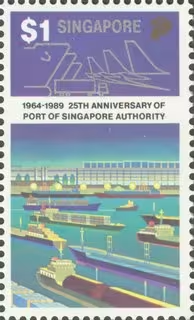
Technical specifications

Denomination10¢, 35¢, 75¢, $1
Stamp Size26mm x 43.5mm
Perforation13¾ x 13¼
PrintingLithography
Sheet Content50 stamps per sheet
PrinterSecura Singapore Pte Ltd
Graphic DesignerNg Keng Seng
Subscribe to newsletter

Stay updated

Subscribe to our newsletter for the latest stamp releases, behind-the-scenes features, and exclusive stories from the vibrant world of philately.