Overview
Insects like the damselfly, bee, wasp and beetle are depicted in this range of eight low-value definitive stamps. This issue together with that of the high-value definitive stamps to be released later in 1985 seeks to record and capture on stamps, some of the insects living in Singapore.
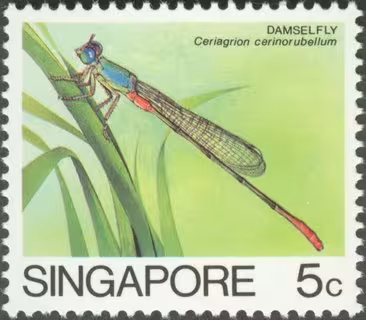
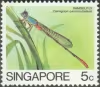
Damselfly (5¢)
Ceriagrion cerinorubellum (Braver)
Order: Odonata
Family: Coenagriidae
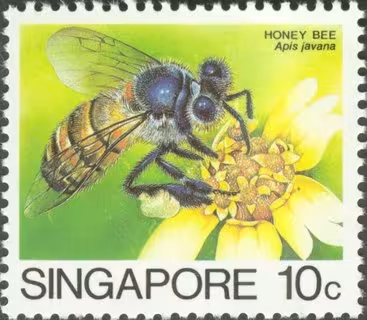
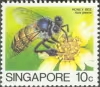
This is one of the commonest damselflies found in Singapore, around still ponds and lakes in which its larvae live. It measures about 40mm long and has a wingspread also about 40mm wide. It is distributed in an area extending from India to Borneo. The adult damselfly feeds on small flies and other flying insects which it catches on the wing while hawking above the water. It is easily recognised by the very slender body with wings folded back to back when it is at rest. Honey Bee (10¢)
Apis javana (Enderlein)
Order: Hymenoptera
Family: Apidae
Apis javana is a common wild honey bee of South-east Asia. It is found in Hainan southwards to Sumatra and from Malaysia eastwards to Ambon. Slightly smaller than the European honey bee, it is gentle and can be domesticated.
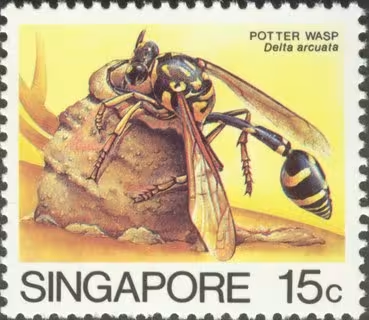
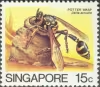
Potter Wasp (15¢)
Delta arcuata (Fabricius)
Order: Hymenoptera
Family: Eumenidae
The mud cells made by potter wasps are a common sight on house walls in the tropics. The big species of Delta make large pots with distinct, flared necks in which they stock caterpillars stung to immobility but not necessarily dead. On this "fresh meat", the larvae will feed. Potter wasps of the genus Delta are large and measure about 30mm long. They are widespread in India and South-east Asia.
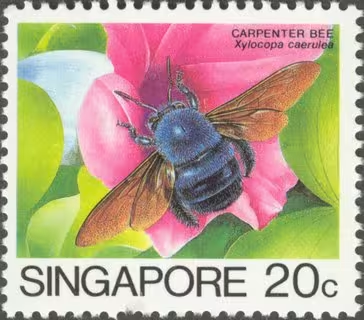
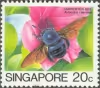
Carpenter Bee (20¢)
Xylocopa caerulea (Fabricius)
Order: Hymenoptera
Family: Anthophoridae
The giant carpenter bees are among the largest and most brightly coloured bees in the world. They nest in holes cut into timber by sawlike blades beneath the head, and there they provision cells with honey and pollen for their young. They fly long distances in search of food and this makes them important in pollination, perhaps especially so for the rain-forest trees. Several kinds of carpenter bees are common in Singapore, including the yellow-backed, the all black and the blue-backed species. Xylocopa caerulea, one of the blue-backed species, flies mainly at dawn and dusk. They measure 25mm long with a wingspread of 55mm wide. Carpenter bees by nature are gentle species and, though possessing a sting, will not attack unless provoked.
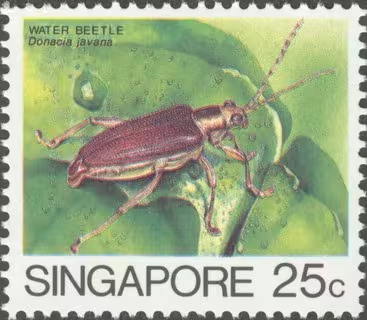
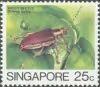
Water Beetle (25¢)
Donacia javana (Wiedemann)
Order: Coleoptera
Family: Chrysomelidae
This little 10mm long beetle is often seen running over the water feeding on the floating leaves of waterlilies in ponds. The silver hairs on its underside trap a film of air, which allows it to breathe underwater without flooding its spiracles (breathing holes). It dives and swims easily and lays eggs in the bottom mud, where the larvae feed on the waterlily roots.
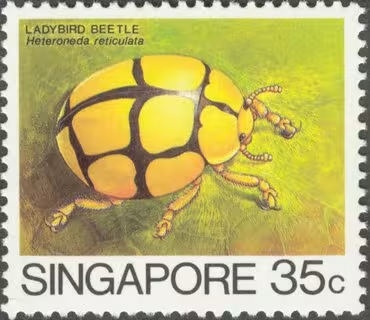
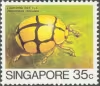
Ladybird Beetle (35¢)
Heteroneda reticulata (Fabricius)
Order: Coleoptera
Family: Coccinellidae
The ladybird beetle that most of us know has a red body with black spots. However, as depicted on the stamps, some species have very different colours and patterns. Like many better known kinds, Heteroneda reticulata preys on greenflies or other small plant pests. It is a forest species that is widespread in South-east Asia. It measures about 4½mm to 5mm long.
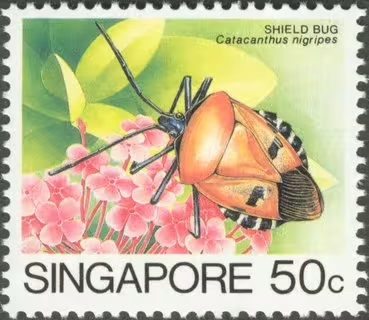
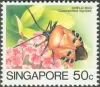
Shield Bug (50¢)
Catacanthus nigripes (Fabricius)
Order: Hemiptera
Family: Pentatomidae
Pentatomidae are one of the several families of bugs with glands that produce a strong smelling secretion as defence against predators. They are called "shield bugs" which describes their characteristic shape, or "stink bugs" because of their defensive secretion. Catacanthus nigripes measures 25mm to 30mm long, and feeds by sucking sap from various plants of the family Rubiaceae, especially the common ornamental shrub, Ixora.
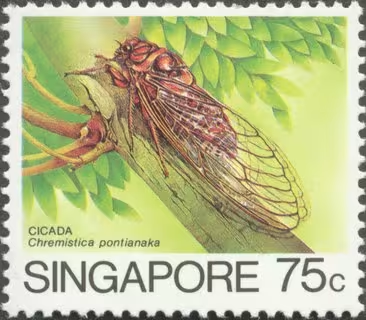
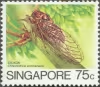
Cicada (75¢)
Chremistica pontianaka (Distant)
Order: Homoptera
Family: Cicadidae
Male cicadas are among the noisiest insects in the forest. Their shrill whine can be heard throughout the day. There are many different species and each has a slightly different song and time of singing. Their singing warns other males to keep their distance and attracts the female cicadas. Chremistica pontianaka as seen here is widespread in South-east Asia.