Overview
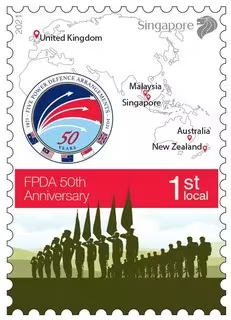
The Five Power Defence Arrangements (FPDA) commemorates its 50th anniversary in 2021. A cornerstone of the regional security architecture, the FPDA has evolved over the past 50 years to tackle new and increasingly complex challenges. The FPDA's Golden Jubilee is a testament to the commitment of its member-nations - Australia, Malaysia, New Zealand, Singapore and the United Kingdom - to strengthen cooperation and support regional peace and security.
Australia, Malaysia, New Zealand, Singapore and the United Kingdom pledged on 16 April 1971 to consult one another on the measures to be taken if Malaysia or Singapore faced external armed aggression or the threat of such aggression. The Five Power Defence Arrangements (FPDA) was thus established on 1 November 1971 for the external defence of Malaysia and Singapore, following the withdrawal of British forces from East of Suez.
In the 2000s, the FPDA entered a new phase of transformation to enhance its ability to deal with emerging non-conventional threats such as terrorism. While conventional elements have remained the mainstay of FPDA exercises, the FPDA has continued to build capacity in areas including counter-terrorism, maritime security, and humanitarian assistance and disaster relief, to keep pace with the evolving security landscape.
Today, the FPDA remains an integral part of the regional security architecture and continues to strengthen cooperation and inter-operability amongst member-nations through regular exercises and professional forums for their officers to interact and exchange views.