Singapore POST

Butterflies

Issue date 03 Mar 1982

Overview

Butterflies Special Stamps The butterflies featured in the present series of stamps are found throughout most of South-East Asia and in areas where there is a predominance of natural vegetation.

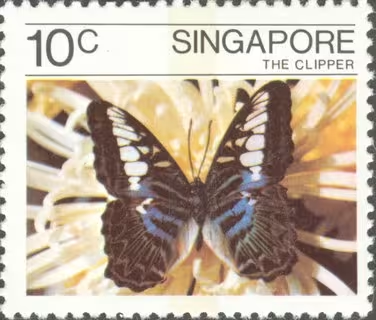
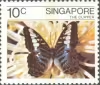
The Clipper (Parthenos sylvia lilacinus), 10¢ This attractive butterfly is black, with blue and green lines and stripes, and the forewing has a series of large, clear white spots. It is most often found at the flowers of Lantana in open country and on the forest edge between December and February. The larva or caterpillar is green to yellowish brown. with dark brown dorsal line, and transverse white dotted segmental lines. The species is found in Sri Lanka, China and the Malay Archipelago.

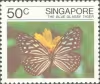
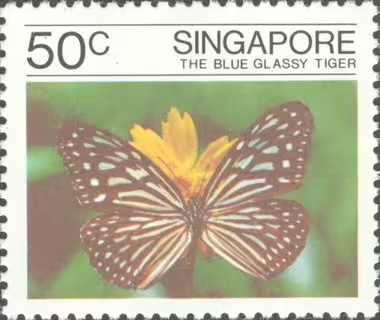
The Blue Glassy Tiger (Radena vulgaris macrina), 50¢ The bluish tinge of Radena vulgaris macrina, commonly known as the Blue Glassy Tiger, is not so apparent in this stamp reproduction. The bluish grey cell streaks on the hindwing of this butterfly form a V with its apex at the base of the wing. The larva of this species is black with numerous small round or homboid white dots. It is very common throughout the Malay Peninsula at all elevations and is distributed from South Burma to Singapore. Indonesia and Borneo.

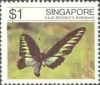
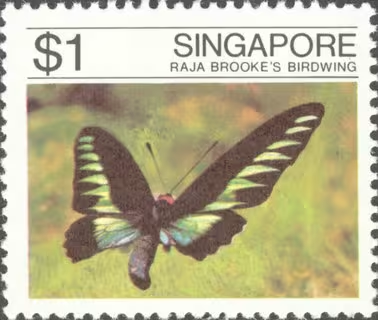
Raja Brooke's Birdwing (Trogonoptera brookiana albescens), $1/- This striking butterfly with a wing span of 15 cm to 17 cm has emerald green, feather-like markings on the velvety black forewings. The female has the green markings conspicuously whitened towards the apex on the forewing and a series of white submarginal spots on the hindwing. Unlike the male it prefers higher ground, occuring from about 230 metres to 1.060 metres and may be found flying around flowering trees. It flies higher than the male, being seen from 6 metres to 12 metres above the ground and often higher. The male is not uncommon along the banks of forest streams at low to moderate elevations and in the vicinity of hot springs. The larva, in its final instar, varies from dark sooty brown to ashy grey: with a lighter grey saddle-mark. The pupa is apple-gree marked with violet. The food plant is a species of climbing Aristolochia. Trogonoptera brookiana albescens is found in Perak, Pahang and Selangor and its subspecies is distributed in Sumatra and Borneo.
Butterflies
Butterflies
Butterflies
Technical specifications
Denomination10¢, 50¢, $1
Stamp Size31.8mm x 26.8mm
Perforation13¾
PrintingLithography
Sheet Content50 stamps per sheet
PrinterJ Waddington
Graphic DesignerEng Siak Loy
Singapore POST
Singapore POST
Singapore POST

Butterflies

Issue date 03 Mar 1982

Butterflies Special Stamps The butterflies featured in the present series of stamps are found throughout most of South-East Asia and in areas where there is a predominance of natural vegetation.

The Clipper (Parthenos sylvia lilacinus), 10¢ This attractive butterfly is black, with blue and green lines and stripes, and the forewing has a series of large, clear white spots. It is most often found at the flowers of Lantana in open country and on the forest edge between December and February. The larva or caterpillar is green to yellowish brown. with dark brown dorsal line, and transverse white dotted segmental lines. The species is found in Sri Lanka, China and the Malay Archipelago.

The Blue Glassy Tiger (Radena vulgaris macrina), 50¢ The bluish tinge of Radena vulgaris macrina, commonly known as the Blue Glassy Tiger, is not so apparent in this stamp reproduction. The bluish grey cell streaks on the hindwing of this butterfly form a V with its apex at the base of the wing. The larva of this species is black with numerous small round or homboid white dots. It is very common throughout the Malay Peninsula at all elevations and is distributed from South Burma to Singapore. Indonesia and Borneo.

Raja Brooke's Birdwing (Trogonoptera brookiana albescens), $1/- This striking butterfly with a wing span of 15 cm to 17 cm has emerald green, feather-like markings on the velvety black forewings. The female has the green markings conspicuously whitened towards the apex on the forewing and a series of white submarginal spots on the hindwing. Unlike the male it prefers higher ground, occuring from about 230 metres to 1.060 metres and may be found flying around flowering trees. It flies higher than the male, being seen from 6 metres to 12 metres above the ground and often higher. The male is not uncommon along the banks of forest streams at low to moderate elevations and in the vicinity of hot springs. The larva, in its final instar, varies from dark sooty brown to ashy grey: with a lighter grey saddle-mark. The pupa is apple-gree marked with violet. The food plant is a species of climbing Aristolochia. Trogonoptera brookiana albescens is found in Perak, Pahang and Selangor and its subspecies is distributed in Sumatra and Borneo.
Denomination

10¢, 50¢, $1

Stamp Size

31.8mm x 26.8mm

Perforation

13¾

Printing

Lithography

Sheet Content

50 stamps per sheet

Printer

J Waddington

Graphic Designer

Eng Siak Loy

Butterflies

Issue date 03 Mar 1982

ButterfliesButterfliesButterflies

Overview

Butterflies Special Stamps The butterflies featured in the present series of stamps are found throughout most of South-East Asia and in areas where there is a predominance of natural vegetation.

The Clipper (Parthenos sylvia lilacinus), 10¢ This attractive butterfly is black, with blue and green lines and stripes, and the forewing has a series of large, clear white spots. It is most often found at the flowers of Lantana in open country and on the forest edge between December and February. The larva or caterpillar is green to yellowish brown. with dark brown dorsal line, and transverse white dotted segmental lines. The species is found in Sri Lanka, China and the Malay Archipelago.

The Blue Glassy Tiger (Radena vulgaris macrina), 50¢ The bluish tinge of Radena vulgaris macrina, commonly known as the Blue Glassy Tiger, is not so apparent in this stamp reproduction. The bluish grey cell streaks on the hindwing of this butterfly form a V with its apex at the base of the wing. The larva of this species is black with numerous small round or homboid white dots. It is very common throughout the Malay Peninsula at all elevations and is distributed from South Burma to Singapore. Indonesia and Borneo.

Raja Brooke's Birdwing (Trogonoptera brookiana albescens), $1/- This striking butterfly with a wing span of 15 cm to 17 cm has emerald green, feather-like markings on the velvety black forewings. The female has the green markings conspicuously whitened towards the apex on the forewing and a series of white submarginal spots on the hindwing. Unlike the male it prefers higher ground, occuring from about 230 metres to 1.060 metres and may be found flying around flowering trees. It flies higher than the male, being seen from 6 metres to 12 metres above the ground and often higher. The male is not uncommon along the banks of forest streams at low to moderate elevations and in the vicinity of hot springs. The larva, in its final instar, varies from dark sooty brown to ashy grey: with a lighter grey saddle-mark. The pupa is apple-gree marked with violet. The food plant is a species of climbing Aristolochia. Trogonoptera brookiana albescens is found in Perak, Pahang and Selangor and its subspecies is distributed in Sumatra and Borneo.
Technical specifications

Denomination10¢, 50¢, $1
Stamp Size31.8mm x 26.8mm
Perforation13¾
PrintingLithography
Sheet Content50 stamps per sheet
PrinterJ Waddington
Graphic DesignerEng Siak Loy
Subscribe to newsletter

Stay updated

Subscribe to our newsletter for the latest stamp releases, behind-the-scenes features, and exclusive stories from the vibrant world of philately.