Overview
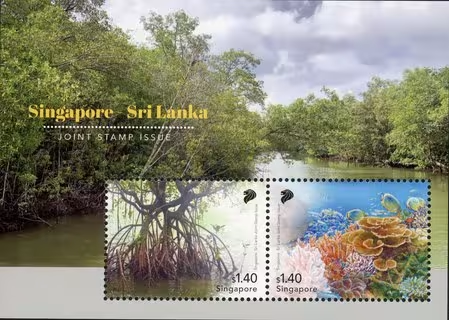
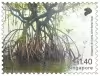
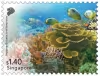
Over the years, Singapore and Sri Lanka enjoy warm and friendly relations with good collaborations. To celebrate the growing bilateral ties of both countries, Singapore Post and Sri Lanka Post jointly release the Singapore-Sri Lanka Joint Stamp Issue, featuring mangroves in Singapore and coral reefs in Sri Lanka.
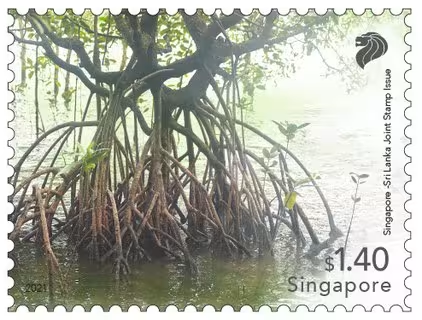
Mangroves Mangroves are a group of shrub and tree species that live along shores, rivers and estuaries in the tropics and subtropics. They are rich ecological habitats for many animals, and serve as important nursery grounds and breeding sites for birds, insects, spiders, fishes, crustaceans, shellfish, reptiles and mammals. Mangroves are resilient and are able to withstand the brunt of flooding, ocean-borne storms and hurricanes. Thus, mangroves play a vital role in coastal protection by preventing shoreline erosion, reducing sedimentation in coastal waters, absorbing pollutants and improving soil chemistry.
There are several local projects and programmes aimed at conserving and rehabilitating mangroves in Singapore. One such project is the Coastal Protection and Restoration of Mangrove Biodiversity at Pulau Tekong by National Parks Board (NParks). The innovative approach involves a combination of hard and soft engineering solutions to arrest the coastal erosion and restore the mangrove areas at the northeastern coastline of the island.
Conservation efforts require ongoing support and commitment from the community. Singapore's mangroves can be preserved and encouraged to grow further with effective mangrove restoration schemes put in place. Regular events such as the annual International Coastal Cleanup also help to raise public local awareness on nature conservation, especially among students.
(Singapore Post)
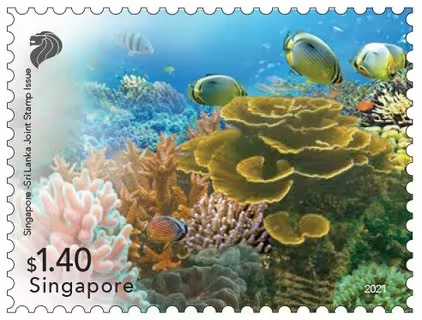
Coral reefs Coral reefs in Sri Lanka, especially near shore reefs are in a really bad condition due to climate change and human induced factors. Unsustainable fisheries practices, unplanned development and coastal and Marine Pollution are major human factors contribute to coral destruction.
Number of measures has been taken to safeguard coral reefs in Sri Lanka. Declaration and establishment of protected areas and restoration of degraded coral reefs, ban and control of unsustainable fisheries practices, improved waste management strategies and sustainable environment management practices are vital in this process.
Effort in coral reef restoration dated back since the 80s. Records indicate that number of methods has been tested and applied in different parts Sri Lanka with different success rates. However, majority of current restoration methods are restricted to the provision of artificial substrates for live coral nubbins. Among them, reef balls, statues and various artificial structures have become favourites.
In most of these methods nubbins are directly attached to solid cement surfaces using epoxy glue or a special pH neutral cement mixture. Most of the cases showed promising survival and growth rates during initial one- or two-year time period, however perished with the rest of the natural coral communities during environmental anomalies. Advantages of these methods are transferability to less vulnerable deeper sites and environmental parameters-controlled ex situ sites during extreme environmental conditions.
(Coral reef restoration by P.B. Terney Pradeep Kumara (Ph.D.))