Dr Chua Eu Tiong is a radiation oncologist in the Singapore General Hospital. He is also an ardent stamp collector who contributes articles regularly for philatelic publications. In the article below, Dr Chua shares with our readers some tips on how to put up a stamp exhibit.
Imagine that you are in the examination hall, (the very central theme in our lives, at one time or another as students or parents of students) planning to answer a question:
"Manned Space Flight"
What in the world has the examination planning technique got to do with the very institution of relaxation - stamp collecting? Everything - well, almost everything, if you want to put up a stamp exhibit. In both the examination and stamp display competition, the students and the exhibitors are being judged.
As in an examination, you have to plan your answer. However, with your stamp exhibits you can plan it at a leisurely pace, in the comfort of your home, with all the research materials at your feet. It would require an introduction, followed by an outline of the topic you are discussing. You would have a "body" and of course a conclusion. Try this in the next attempt at an examination question, and you would be rewarded by very good marks from your teachers. Why is this so? Examiners, like judges at an exhibition, have very little time to extract the information from the answer. The judges have to run over many exhibits and the ones laid out logically will impress them. They tell the judges that the exhibitor has put in some thought.
Imagine the hundreds of papers the examiners have to correct. For the same reason, neatness is a prerequisite in an exhibit. Do not cram too much on an album page. Space out the items and put in sub-headings, like in an examination.
What about the amount of information? Well, like in an answer paper, examiners will know whether there is too much information or too little. An exhibit that covers a topic too sparsely, no matter how much the exhibitor likes that subject or part of it, should have the number of pages trimmed.
I am sure you will next ask how much is too much, and how little is too little. Experience will tell, but this is not too specific an answer, is it? You can gain knowledge by attending exhibitions and seeing how prize-winning exhibits are laid out.
Generally, stamps in sets should be given ample space with margins around the sheet, and should be arranged in a manner so that the most valuable or highest-value stamp in the set is given emphasis. It is the art of being able to give emphasis to the material that will attract the busy judges' attention. Similarly, two covers on an album page is the acceptable norm. A single cover may occupy a single page if it is a valuable item.
Three overlapping covers are sometimes used but this generally becomes untidy and more often than not, the covers depicted are repetitive.
Using the earlier-mentioned subject "Manned Space Flight", the first page in this exhibit or examination answer should have an interesting introduction, perhaps like,
"We were beaten into space by a dog and a monkey, one a man's best friend, and the other a worthy forerunner."
One can go on to describe a short history of manned space flight and the introduction can be followed by laying out the exhibit in several frames, such as follows:
Frame 1: Exploration of space as a forerunner of manned space flights.
Frame 2: The Russian programme - Vostok, Voskhod, Soyuz.
Frame 3: The American programme - Mercury, Gemini, Apollo, Shuttles.
Frame 4: The Race to the Moon.
Frame 5: Beyond the Moon.
The above is an example of a thematic collection. What about the more usual country collections or traditional and postal history exhibit? By illustrating how such an exhibit can be put up is the best way to get the message across to all you aspiring stamp exhibitors.
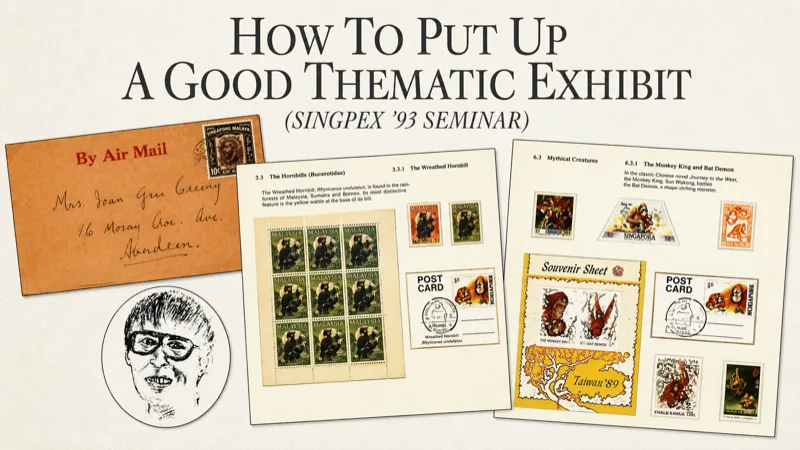
Figure 1 shows the first page in an exhibit on flight covers or airmail of Singapore and the Straits Settlements. The exhibit is written out in manuscript style, using a fountain pen with a broad nib to give thin and thick lines. It gives a short introduction and presents to the audience the development of airmail in this region undertaken by the various airlines. It also illustrates routes, pioneering flights and crash covers. These are all laid out in the first page. Having seen the plan, the judges can delve into the whole exhibit, savouring the finer points that each cover conveys. (Figure 2)
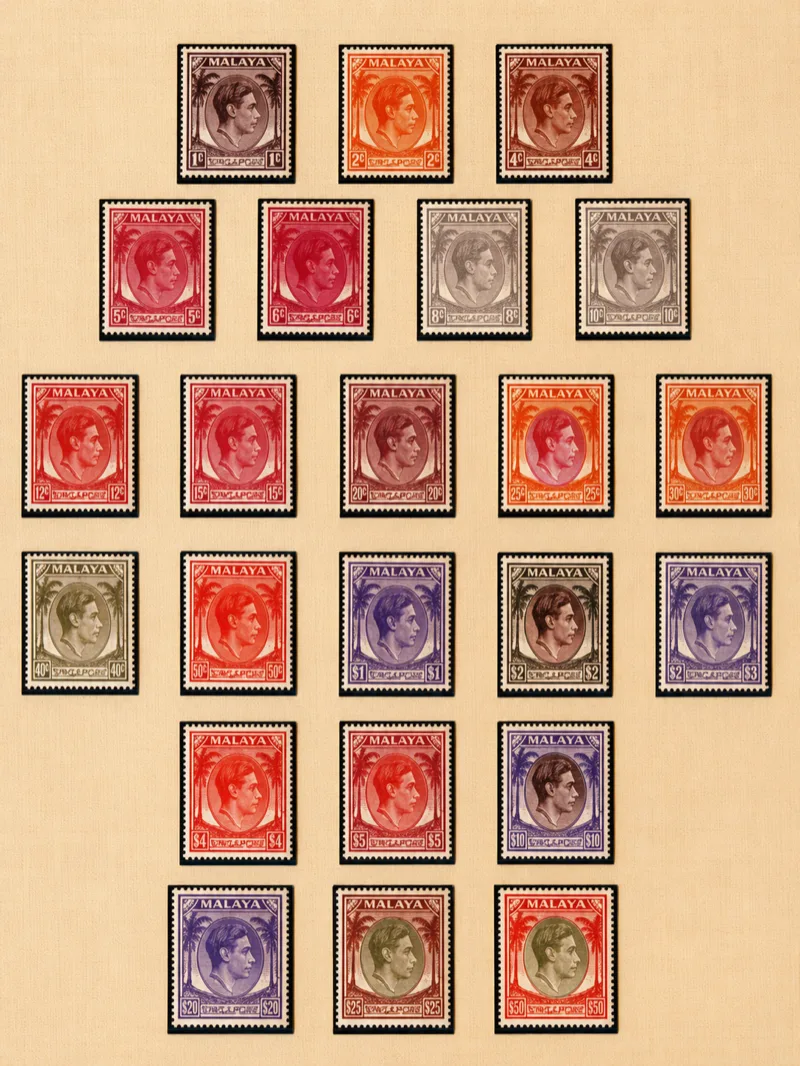
For a more traditional exhibit of stamps, Figure 3 illustrates how stamps can be laid out on an album page. Avoid cluttering. It shows how a set of stamps is arranged giving emphasis to the higher value stamps. Figure 4 shows a more specialised aspect of the same collection and their dates of issue. These two pages are the first two definitive sets of Singapore stamps issued between 1948 and 1952.
Sometimes, covers or large philatelic pieces have to be exhibited. I have chosen aerogrammes to illustrate the point. Figure 5 shows two overlapping aerogrammes. The essential differences are still displayed and the page is kept neat. Continuous display of such items can be a bit trying, so it may be prudent to intersperse it with smaller items. Figure 6 illustrates the use of album pages which should be white or cream. It must not be distracting. If one uses ink, the base must be smooth and the paper choice becomes limited. There are specially cut papers of the right size for exhibiting and there are special mounts, corners and protective plastic coverings all prepared for the exhibitor. A whole industry of such philatelic accessories has sprung up to cater to the needs of exhibitors.
I am certain volumes can be written on this subject but the beauty of stamp collecting lies somewhere beyond the confines of these rules for exhibiting. It must be that little hallmark of individuality that the judges look for that makes it an outstanding and award-winning collection.