Singapore POST

Skyrise Greenery

Issue date 01 Jul 2021

Overview

Skyrise greenery, a uniquely Singapore term, has become pervasive in our cityscape today. In the last 20 years, skyrise greenery in Singapore has grown and flourished, shaped by the creativity and passion of many built environment talents in the public, private and people sectors, working together.

While the idea of greening buildings is common today, it was considered a new and challenging frontier 20 years ago. Although the idea appears simple, the technical and maintenance challenges were considerable. Early efforts saw some pioneering examples of rooftop gardens incorporated into commercial buildings and planters on facades of buildings.

From the 1990s, a series of skyrise garden exhibitions by the National Parks Board raised awareness on skyrise greenery by encouraging Singaporeans to take up gardening in their high-rise apartments. Efforts gained momentum in the early 2000s, with a wider and more coordinated adoption under the Garden City Action Committee. This was with the vision and intent to further extend and expand Singapore as a Garden City, in creating an extensive and seamless green experience even on vertical spaces. Efforts were also shaped by the focus on creating more sustainable architecture and studies showing the benefits of skyrise greenery.

Over the years, new urban greening policies have been introduced in line with the evolving form and character of skyrise greenery in Singapore. Initiated in 2009 as a consolidated urban and skyrise greening scheme comprising incentives and requirements, URA's Landscaping for Urban Spaces and High-Rises (LUSH) programme is a key initiative that capitalises on development to inject more greenery into the city. The programme has encouraged and inspired a greater adoption of skyrise greenery over the years, by replacing part of the greenery that has been taken away from a building site onto the multitude of vertical and horizontal, exterior and interior spaces in a building through innovative designs and technology.

Since its inception, the programme has expanded its reach to more locations and types of developments and included a wider range of incentives to encourage greenery provision. As of end-2020, the LUSH scheme has played a key role in the introduction of more than 250 hectares of greenery among new developments in the past decade.

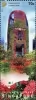
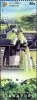
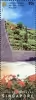
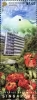
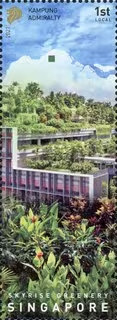
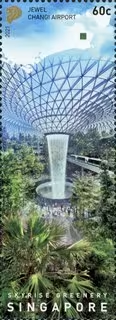
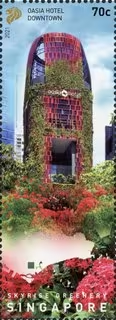
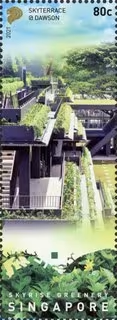
The Skyrise Greenery commemorative stamps celebrate skyrise greenery projects in the last 10 years that have further expanded the notion of skyrise greenery, inspiring new possibilities and frontiers, in shaping Singapore as a City in Nature.

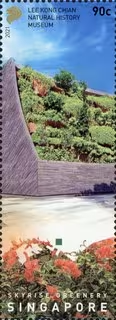
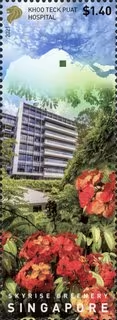
Among the developments featured in the stamp series, Jewel Changi Airport, Kampung Admiralty, Khoo Teck Puat Hospital, Oasia Downtown Hotel and SkyTerrace@Dawson are President's Design Award (PDA) Design of the Year winners. The Lee Kong Chian Natural History Museum was designed by PDA Designer of the Year recipients, Mok Wei Wei (W Architects Pte Ltd) and Franklin Po (Tierra Design (S) Pte Ltd).
Skyrise Greenery
Skyrise Greenery
Skyrise Greenery
Skyrise Greenery
Skyrise Greenery
Skyrise Greenery
Technical specifications
Denomination1st Local, 60¢, 70¢, 80¢, 90¢, $1.40
Stamp Size29.85mm x 81.6mm
Perforation13.0
Paperunwatermarked
PrintingOffset Lithography
Sheet Content10 stamps per sheet
PrinterSecura Singapore Pte Ltd
Graphic DesignerWong Wui Kong
Singapore POST
Singapore POST
Singapore POST
Singapore POST
Singapore POST
Singapore POST

Skyrise Greenery

Issue date 01 Jul 2021

Skyrise greenery, a uniquely Singapore term, has become pervasive in our cityscape today. In the last 20 years, skyrise greenery in Singapore has grown and flourished, shaped by the creativity and passion of many built environment talents in the public, private and people sectors, working together.

While the idea of greening buildings is common today, it was considered a new and challenging frontier 20 years ago. Although the idea appears simple, the technical and maintenance challenges were considerable. Early efforts saw some pioneering examples of rooftop gardens incorporated into commercial buildings and planters on facades of buildings.

From the 1990s, a series of skyrise garden exhibitions by the National Parks Board raised awareness on skyrise greenery by encouraging Singaporeans to take up gardening in their high-rise apartments. Efforts gained momentum in the early 2000s, with a wider and more coordinated adoption under the Garden City Action Committee. This was with the vision and intent to further extend and expand Singapore as a Garden City, in creating an extensive and seamless green experience even on vertical spaces. Efforts were also shaped by the focus on creating more sustainable architecture and studies showing the benefits of skyrise greenery.

Over the years, new urban greening policies have been introduced in line with the evolving form and character of skyrise greenery in Singapore. Initiated in 2009 as a consolidated urban and skyrise greening scheme comprising incentives and requirements, URA's Landscaping for Urban Spaces and High-Rises (LUSH) programme is a key initiative that capitalises on development to inject more greenery into the city. The programme has encouraged and inspired a greater adoption of skyrise greenery over the years, by replacing part of the greenery that has been taken away from a building site onto the multitude of vertical and horizontal, exterior and interior spaces in a building through innovative designs and technology.

Since its inception, the programme has expanded its reach to more locations and types of developments and included a wider range of incentives to encourage greenery provision. As of end-2020, the LUSH scheme has played a key role in the introduction of more than 250 hectares of greenery among new developments in the past decade.

The Skyrise Greenery commemorative stamps celebrate skyrise greenery projects in the last 10 years that have further expanded the notion of skyrise greenery, inspiring new possibilities and frontiers, in shaping Singapore as a City in Nature.

Among the developments featured in the stamp series, Jewel Changi Airport, Kampung Admiralty, Khoo Teck Puat Hospital, Oasia Downtown Hotel and SkyTerrace@Dawson are President's Design Award (PDA) Design of the Year winners. The Lee Kong Chian Natural History Museum was designed by PDA Designer of the Year recipients, Mok Wei Wei (W Architects Pte Ltd) and Franklin Po (Tierra Design (S) Pte Ltd).
Denomination

1st Local, 60¢, 70¢, 80¢, 90¢, $1.40

Stamp Size

29.85mm x 81.6mm

Perforation

13.0

Paper

unwatermarked

Printing

Offset Lithography

Sheet Content

10 stamps per sheet

Printer

Secura Singapore Pte Ltd

Graphic Designer

Wong Wui Kong

Skyrise Greenery

Issue date 01 Jul 2021

Skyrise GreenerySkyrise GreenerySkyrise GreenerySkyrise GreenerySkyrise GreenerySkyrise Greenery

Overview

Skyrise greenery, a uniquely Singapore term, has become pervasive in our cityscape today. In the last 20 years, skyrise greenery in Singapore has grown and flourished, shaped by the creativity and passion of many built environment talents in the public, private and people sectors, working together.

While the idea of greening buildings is common today, it was considered a new and challenging frontier 20 years ago. Although the idea appears simple, the technical and maintenance challenges were considerable. Early efforts saw some pioneering examples of rooftop gardens incorporated into commercial buildings and planters on facades of buildings.

From the 1990s, a series of skyrise garden exhibitions by the National Parks Board raised awareness on skyrise greenery by encouraging Singaporeans to take up gardening in their high-rise apartments. Efforts gained momentum in the early 2000s, with a wider and more coordinated adoption under the Garden City Action Committee. This was with the vision and intent to further extend and expand Singapore as a Garden City, in creating an extensive and seamless green experience even on vertical spaces. Efforts were also shaped by the focus on creating more sustainable architecture and studies showing the benefits of skyrise greenery.

Over the years, new urban greening policies have been introduced in line with the evolving form and character of skyrise greenery in Singapore. Initiated in 2009 as a consolidated urban and skyrise greening scheme comprising incentives and requirements, URA's Landscaping for Urban Spaces and High-Rises (LUSH) programme is a key initiative that capitalises on development to inject more greenery into the city. The programme has encouraged and inspired a greater adoption of skyrise greenery over the years, by replacing part of the greenery that has been taken away from a building site onto the multitude of vertical and horizontal, exterior and interior spaces in a building through innovative designs and technology.

Since its inception, the programme has expanded its reach to more locations and types of developments and included a wider range of incentives to encourage greenery provision. As of end-2020, the LUSH scheme has played a key role in the introduction of more than 250 hectares of greenery among new developments in the past decade.

The Skyrise Greenery commemorative stamps celebrate skyrise greenery projects in the last 10 years that have further expanded the notion of skyrise greenery, inspiring new possibilities and frontiers, in shaping Singapore as a City in Nature.

Among the developments featured in the stamp series, Jewel Changi Airport, Kampung Admiralty, Khoo Teck Puat Hospital, Oasia Downtown Hotel and SkyTerrace@Dawson are President's Design Award (PDA) Design of the Year winners. The Lee Kong Chian Natural History Museum was designed by PDA Designer of the Year recipients, Mok Wei Wei (W Architects Pte Ltd) and Franklin Po (Tierra Design (S) Pte Ltd).
Technical specifications

Denomination1st Local, 60¢, 70¢, 80¢, 90¢, $1.40
Stamp Size29.85mm x 81.6mm
Perforation13.0
Paperunwatermarked
PrintingOffset Lithography
Sheet Content10 stamps per sheet
PrinterSecura Singapore Pte Ltd
Graphic DesignerWong Wui Kong
Subscribe to newsletter

Stay updated

Subscribe to our newsletter for the latest stamp releases, behind-the-scenes features, and exclusive stories from the vibrant world of philately.