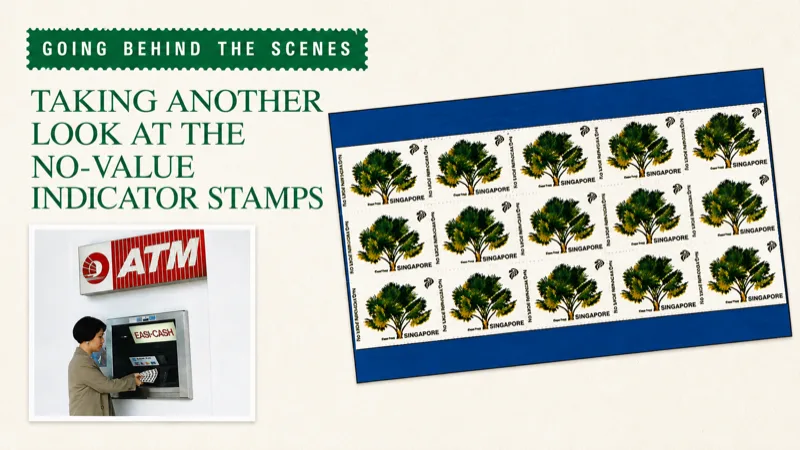
In November last year, an innovative new product in the form of the no-value indicator, self-adhesive, Automated Teller Machine (ATM) stamp made its debut in the market. Collectors and users of the product have given good feedback as to the pleasant design and the peel and stick nature of the stamp.
Looking at the humble stamp, you may not realise the length of time and the extent of effort that were put in to produce it. It is not the fact that it has no value printed on it nor is it the fact that it is self-adhesive that makes the product revolutionary. It is unique because the stamp is dispensed from bank ATMs, a process that would not have been possible without years of extensive research and testing undertaken by the country that first introduced the product, the United States of America.
Singapore is the second country after the United States and the first in Asia to release stamps dispensed from bank ATMs. Without doubt, the onpassing of valuable tips and the sharing of expertise from the United States postal administrations have been instrumental in the smooth launch of this new product. Nevertheless, its introduction would still not be possible without the involvement of many parties, of which NCR Singapore played the biggest part.
Recognising the complexity of producing such a product, Singapore Post took the unprecedented step of awarding the contract to source, test, evaluate and supply the stamps to NCR by waiver of competition. NCR, being the supplier to OCBC ATMs where the stamps will be sold, is the most qualified to undertake the extensive tests from prototype to final product.
As NCR is not a security printer, they had to jointly source for suitable suppliers from the handful of security stamp printers with Singapore Post. The sourcing and testing started in early 1991. From the numerous discussions with management, two were finally shortlisted. From then on, NCR worked closely with them and Singapore Post to develop a prototype for testing based on the very stringent specifications drawn up by NCR for the type of media that is acceptable by NCR ATMs.
The critical criteria is that the stamps should be able to be dispensed from the ATMs as smoothly as currency notes, for on that hinges the success of the project.
Among the specifications are the thinness of the sheets that can pass through the rollers of the ATMs effectively, adherence to correct roughness range to ensure no double pick of the stamp sheets and correct quality of glue as any oozing of glue will cause friction.
To meet all these criteria and more, you can never imagine the batches and batches of samples that were tested and re-tested not only at NCR Singapore but in NCR Dundee in the United Kingdom where NCR ATMs are manufactured.
After many laborious but necessary rounds of testing, NCR and Singapore Post finally decided on Avery Dennison of the United States. Avery has the advantage of having printed the ATM stamps in the United States. But even with their experience, several testings and further refinement of the quality of the final product were made before it was finally approved for mass production in September 1993.
When the stamps were successfully launched on 24 November 1993, all the parties involved in the production heaved a great sigh of relief and shared in the pride and joy of having participated in the process of developing a product that is so rudimentary of the service provided to customers of Singapore Post and OCBC Bank.
The no-value indicator self-adhesive stamps are sold in sheets of 15 stamps. The stamps take on the value of the basic domestic letter. Priced at 20¢ a sheet, they are available at 70 OCBC ATMs all over Singapore.