Singapore POST

20 Years of National Service

Issue date 01 Jul 1987

Overview

Between 1854, when the then Singapore Volunteer Rifle Corps was formed, and our independence in 1965, Singapore had survived a World War, suffered the indignity of a Japanese Occupation and struggled against communist insurgents. Through these fires of baptism, nationhood was forged. Armed with only two infantry battalions, two modest training ships and no air force whatsoever, Singapore stood alone facing the economic and political uncertainties that came with independence. There was a pressing need for a credible armed force and the question of how to create a viable one, in view of Singapore's limited manpower and economic resources.

The only logical way was to create a citizen army with a small regular corps of professional soldiers.

In 1967, National Service was introduced. Able-bodied young men, 18 years of age, were enlisted to serve a period of two or two-and-a-haif years in the armed forces.

Twenty years after its introduction, Singapore has built up a reserve force of 200,000 frontline soldiers from diverse ethnic, cultural and social background. Yet, unmistakebly, there is a unique culture and sense of camaraderie among the men.

The SAF today is a tightly-knit, highly efficient fighting force comprising well-trained, disciplined soldiers, active and reservists, who are capable of operating sophisticated weapon systems. In a matter of hours it can mobilise an army of men, fully equipped, fully trained and ready for combat. It maintains a credible air defence shield with one of the best air forces in the region, and ensures the safety of our sea lanes with a navy armed with advanced missile and radar systems. The three services are trained to operate as one armed force to achieve even greater effectiveness in the defence of the nation.

The Ministry of Defence is responsible for the Military Defence aspect of Total Defence. Military Defence is the maintenance of a high degree of operational readiness and fighting capability of the SAF so that it can act decisively and effectively if deterrence and diplomacy fail. This operational readiness is regularly tested through exercises such as Civil Resource Requisition, both land and sea. and the Open Mobilisation of reservists.

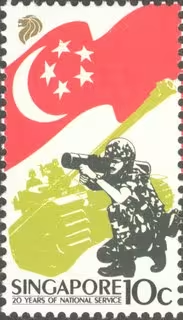
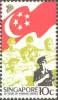
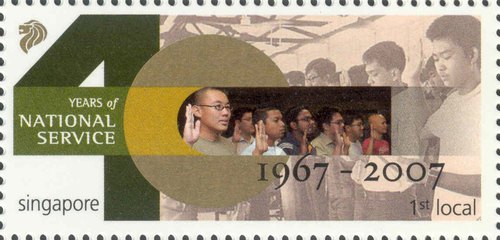
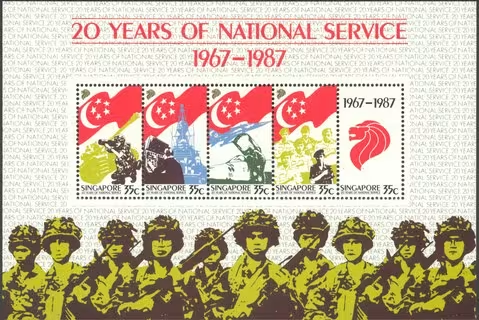
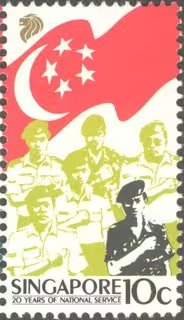
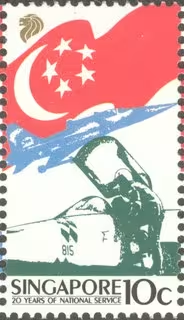
Depicted on the first three stamps are the Army, Navy and Air Force servicemen in the various disciplines of training, each against the background of the Singapore Lion and state flag. The fourth stamp shows all national servicemen pledging allegiance to the nation.

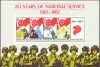
Depicted on the miniature sheet as a fifth stamp is the Singapore Lion, the Republic's national symbol of courage, strength and ex-cellence. It is in solid red against a white background, the colours of the Singapore flag. The mane of the lion divides into five segments, each representing the nation's five ideals as embodied in the five stars on the flag- democracy, peace, progress, justice and equality. The lion's face is fixed unswervingly on the tasks at hand and beyond to the future. This is symbolic of our nation's single-minded resolve to face any foe and overcome any obstacle.

National servicemen are the personification of the young Singapore Lion: courageous and strong, fighting-fit and ready They represent a nation united with the ideals, a nation with the courage and the resolve to defend and to achieve excellence for Singapore.
20 Years of National Service
Technical specifications
Denomination10¢, 10¢, 10¢, 10¢
Stamp Size20.3mm x 35.7mm
Miniature Sheet Size148mm x 100mm
Perforation14¾ x 14
PrintingLithography
Sheet Content40 stamps per sheet
PrinterQuesta
Graphic DesignerMelvin Ng Puay Chiew
Singapore POST
Singapore POST
Singapore POST
Singapore POST
Singapore POST

20 Years of National Service

Issue date 01 Jul 1987

Between 1854, when the then Singapore Volunteer Rifle Corps was formed, and our independence in 1965, Singapore had survived a World War, suffered the indignity of a Japanese Occupation and struggled against communist insurgents. Through these fires of baptism, nationhood was forged. Armed with only two infantry battalions, two modest training ships and no air force whatsoever, Singapore stood alone facing the economic and political uncertainties that came with independence. There was a pressing need for a credible armed force and the question of how to create a viable one, in view of Singapore's limited manpower and economic resources.

The only logical way was to create a citizen army with a small regular corps of professional soldiers.

In 1967, National Service was introduced. Able-bodied young men, 18 years of age, were enlisted to serve a period of two or two-and-a-haif years in the armed forces.

Twenty years after its introduction, Singapore has built up a reserve force of 200,000 frontline soldiers from diverse ethnic, cultural and social background. Yet, unmistakebly, there is a unique culture and sense of camaraderie among the men.

The SAF today is a tightly-knit, highly efficient fighting force comprising well-trained, disciplined soldiers, active and reservists, who are capable of operating sophisticated weapon systems. In a matter of hours it can mobilise an army of men, fully equipped, fully trained and ready for combat. It maintains a credible air defence shield with one of the best air forces in the region, and ensures the safety of our sea lanes with a navy armed with advanced missile and radar systems. The three services are trained to operate as one armed force to achieve even greater effectiveness in the defence of the nation.

The Ministry of Defence is responsible for the Military Defence aspect of Total Defence. Military Defence is the maintenance of a high degree of operational readiness and fighting capability of the SAF so that it can act decisively and effectively if deterrence and diplomacy fail. This operational readiness is regularly tested through exercises such as Civil Resource Requisition, both land and sea. and the Open Mobilisation of reservists.

Depicted on the first three stamps are the Army, Navy and Air Force servicemen in the various disciplines of training, each against the background of the Singapore Lion and state flag. The fourth stamp shows all national servicemen pledging allegiance to the nation.

Depicted on the miniature sheet as a fifth stamp is the Singapore Lion, the Republic's national symbol of courage, strength and ex-cellence. It is in solid red against a white background, the colours of the Singapore flag. The mane of the lion divides into five segments, each representing the nation's five ideals as embodied in the five stars on the flag- democracy, peace, progress, justice and equality. The lion's face is fixed unswervingly on the tasks at hand and beyond to the future. This is symbolic of our nation's single-minded resolve to face any foe and overcome any obstacle.

National servicemen are the personification of the young Singapore Lion: courageous and strong, fighting-fit and ready They represent a nation united with the ideals, a nation with the courage and the resolve to defend and to achieve excellence for Singapore.
Denomination

10¢, 10¢, 10¢, 10¢

Stamp Size

20.3mm x 35.7mm

Miniature Sheet Size

148mm x 100mm

Perforation

14¾ x 14

Printing

Lithography

Sheet Content

40 stamps per sheet

Printer

Questa

Graphic Designer

Melvin Ng Puay Chiew

20 Years of National Service

Issue date 01 Jul 1987

20 Years of National Service20 Years of National Service20 Years of National Service20 Years of National Service20 Years of National Service

Overview

Between 1854, when the then Singapore Volunteer Rifle Corps was formed, and our independence in 1965, Singapore had survived a World War, suffered the indignity of a Japanese Occupation and struggled against communist insurgents. Through these fires of baptism, nationhood was forged. Armed with only two infantry battalions, two modest training ships and no air force whatsoever, Singapore stood alone facing the economic and political uncertainties that came with independence. There was a pressing need for a credible armed force and the question of how to create a viable one, in view of Singapore's limited manpower and economic resources.

The only logical way was to create a citizen army with a small regular corps of professional soldiers.

In 1967, National Service was introduced. Able-bodied young men, 18 years of age, were enlisted to serve a period of two or two-and-a-haif years in the armed forces.

Twenty years after its introduction, Singapore has built up a reserve force of 200,000 frontline soldiers from diverse ethnic, cultural and social background. Yet, unmistakebly, there is a unique culture and sense of camaraderie among the men.

The SAF today is a tightly-knit, highly efficient fighting force comprising well-trained, disciplined soldiers, active and reservists, who are capable of operating sophisticated weapon systems. In a matter of hours it can mobilise an army of men, fully equipped, fully trained and ready for combat. It maintains a credible air defence shield with one of the best air forces in the region, and ensures the safety of our sea lanes with a navy armed with advanced missile and radar systems. The three services are trained to operate as one armed force to achieve even greater effectiveness in the defence of the nation.

The Ministry of Defence is responsible for the Military Defence aspect of Total Defence. Military Defence is the maintenance of a high degree of operational readiness and fighting capability of the SAF so that it can act decisively and effectively if deterrence and diplomacy fail. This operational readiness is regularly tested through exercises such as Civil Resource Requisition, both land and sea. and the Open Mobilisation of reservists.

Depicted on the first three stamps are the Army, Navy and Air Force servicemen in the various disciplines of training, each against the background of the Singapore Lion and state flag. The fourth stamp shows all national servicemen pledging allegiance to the nation.

Depicted on the miniature sheet as a fifth stamp is the Singapore Lion, the Republic's national symbol of courage, strength and ex-cellence. It is in solid red against a white background, the colours of the Singapore flag. The mane of the lion divides into five segments, each representing the nation's five ideals as embodied in the five stars on the flag- democracy, peace, progress, justice and equality. The lion's face is fixed unswervingly on the tasks at hand and beyond to the future. This is symbolic of our nation's single-minded resolve to face any foe and overcome any obstacle.

National servicemen are the personification of the young Singapore Lion: courageous and strong, fighting-fit and ready They represent a nation united with the ideals, a nation with the courage and the resolve to defend and to achieve excellence for Singapore.

Technical specifications

Denomination10¢, 10¢, 10¢, 10¢
Stamp Size20.3mm x 35.7mm
Miniature Sheet Size148mm x 100mm
Perforation14¾ x 14
PrintingLithography
Sheet Content40 stamps per sheet
PrinterQuesta
Graphic DesignerMelvin Ng Puay Chiew
Subscribe to newsletter

Stay updated

Subscribe to our newsletter for the latest stamp releases, behind-the-scenes features, and exclusive stories from the vibrant world of philately.