Singapore POST

25 Years of Television

Issue date 04 Apr 1988

Overview

On 2nd April 1963, after a brief period of test transmissions and a pilot service, Singapore entered the television age with the inauguration of a regular television service in the 4 languages.

That day's offering was a mix of programmes -news, music, dance, all locally produced, and some imported fare. The television service was introduced at a critical time in Singapore's history. It was a time when fundamental values, indeed the very identity of Singapore as a state, were being debated. TV proved to be an effective channel to communicate new ideas, and to establish a consensus on the sort of society we were to be

25 years later, the service has grown tremendously. From a single monochrome channel, today there are 3 colour channels transmitting 156 hours of programmes weekly. Programmes range from news with satellite inserts, regional reports and coverages of Parliamentary proceedings to music and dance performed by local and international stars and Mandarin dramas with historical and contemporary themes. All in, it's now a service that has led to almost every Singaporean household owning a TV set. It's a service that can muster audiences of more than a million viewers for a single show.

Its qualitative improvements have been such that besides contributing to furthering Singapore's image abroad, it is on the threshold of winning over a sizable overseas market for its drama output.

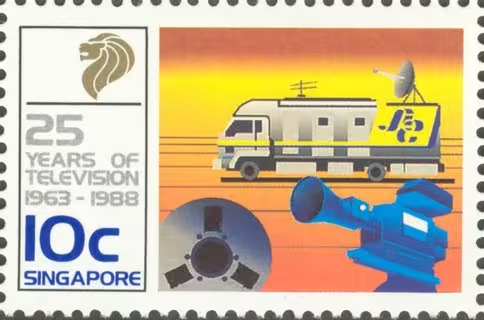
The 10 cent stamp depicts an outside broadcast van (the production control centre), a field camera (for video pictures) and a tape spool (for recording pictures). The outside broadcast van is used to record special events at venues outside the studio: for instance, the National Day Parade at the Padang

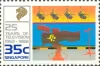
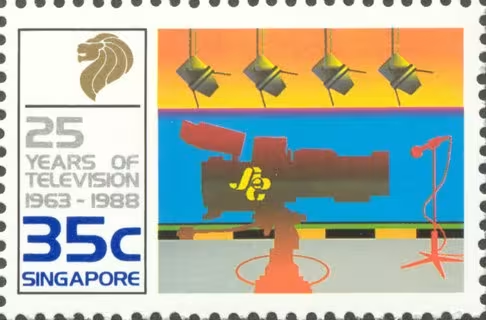
The 35 cent stamp depicts a TV studio-the place where the great majority of SBC's TV programmes are produced. Selected for highlighting are key pieces of equipment- lighting. camera and microphone without which no programme can be produceа

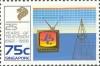
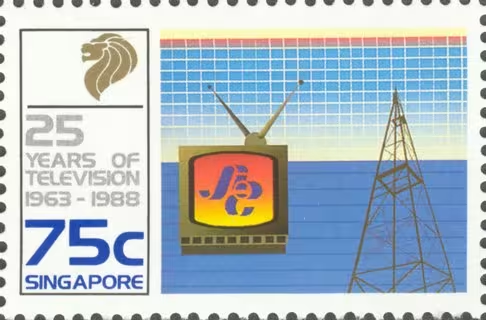
The 75 cent stamp illustrates a transmitting tower and a TV receiver set with an antenna. These are used for the telecast and reception of TV programmes.

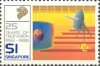
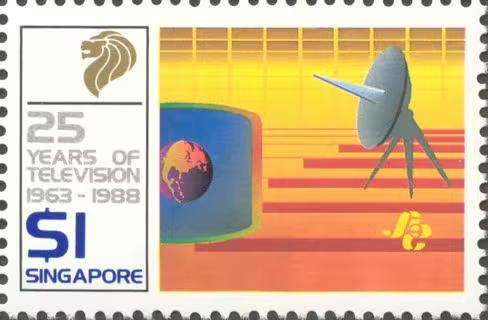
The $1 stamp shows a telecommunications satellite dish antenna and the globe on a TV screen. Events taking place around the world are transmitted via a communication satellite in space for reception by TV stations. This is another means by which TV programmes and especially 'live transmissions from abroad are relayed.
25 Years of Television
Technical specifications
Denomination10¢, 35¢, 75¢, $1
Stamp Size37.5mm x 24.5mm
Perforation13¼ x 13¼
PrintingLithography
Sheet Content50 stamps per sheet
PrinterCPE Australia
Graphic DesignerEd Soriano
Singapore POST
Singapore POST
Singapore POST
Singapore POST

25 Years of Television

Issue date 04 Apr 1988

On 2nd April 1963, after a brief period of test transmissions and a pilot service, Singapore entered the television age with the inauguration of a regular television service in the 4 languages.

That day's offering was a mix of programmes -news, music, dance, all locally produced, and some imported fare. The television service was introduced at a critical time in Singapore's history. It was a time when fundamental values, indeed the very identity of Singapore as a state, were being debated. TV proved to be an effective channel to communicate new ideas, and to establish a consensus on the sort of society we were to be

25 years later, the service has grown tremendously. From a single monochrome channel, today there are 3 colour channels transmitting 156 hours of programmes weekly. Programmes range from news with satellite inserts, regional reports and coverages of Parliamentary proceedings to music and dance performed by local and international stars and Mandarin dramas with historical and contemporary themes. All in, it's now a service that has led to almost every Singaporean household owning a TV set. It's a service that can muster audiences of more than a million viewers for a single show.

Its qualitative improvements have been such that besides contributing to furthering Singapore's image abroad, it is on the threshold of winning over a sizable overseas market for its drama output.

The 10 cent stamp depicts an outside broadcast van (the production control centre), a field camera (for video pictures) and a tape spool (for recording pictures). The outside broadcast van is used to record special events at venues outside the studio: for instance, the National Day Parade at the Padang

The 35 cent stamp depicts a TV studio-the place where the great majority of SBC's TV programmes are produced. Selected for highlighting are key pieces of equipment- lighting. camera and microphone without which no programme can be produceа

The 75 cent stamp illustrates a transmitting tower and a TV receiver set with an antenna. These are used for the telecast and reception of TV programmes.

The $1 stamp shows a telecommunications satellite dish antenna and the globe on a TV screen. Events taking place around the world are transmitted via a communication satellite in space for reception by TV stations. This is another means by which TV programmes and especially 'live transmissions from abroad are relayed.
Denomination

10¢, 35¢, 75¢, $1

Stamp Size

37.5mm x 24.5mm

Perforation

13¼ x 13¼

Printing

Lithography

Sheet Content

50 stamps per sheet

Printer

CPE Australia

Graphic Designer

Ed Soriano

25 Years of Television

Issue date 04 Apr 1988

25 Years of Television25 Years of Television25 Years of Television25 Years of Television

Overview

On 2nd April 1963, after a brief period of test transmissions and a pilot service, Singapore entered the television age with the inauguration of a regular television service in the 4 languages.

That day's offering was a mix of programmes -news, music, dance, all locally produced, and some imported fare. The television service was introduced at a critical time in Singapore's history. It was a time when fundamental values, indeed the very identity of Singapore as a state, were being debated. TV proved to be an effective channel to communicate new ideas, and to establish a consensus on the sort of society we were to be

25 years later, the service has grown tremendously. From a single monochrome channel, today there are 3 colour channels transmitting 156 hours of programmes weekly. Programmes range from news with satellite inserts, regional reports and coverages of Parliamentary proceedings to music and dance performed by local and international stars and Mandarin dramas with historical and contemporary themes. All in, it's now a service that has led to almost every Singaporean household owning a TV set. It's a service that can muster audiences of more than a million viewers for a single show.

Its qualitative improvements have been such that besides contributing to furthering Singapore's image abroad, it is on the threshold of winning over a sizable overseas market for its drama output.

The 10 cent stamp depicts an outside broadcast van (the production control centre), a field camera (for video pictures) and a tape spool (for recording pictures). The outside broadcast van is used to record special events at venues outside the studio: for instance, the National Day Parade at the Padang

The 35 cent stamp depicts a TV studio-the place where the great majority of SBC's TV programmes are produced. Selected for highlighting are key pieces of equipment- lighting. camera and microphone without which no programme can be produceа

The 75 cent stamp illustrates a transmitting tower and a TV receiver set with an antenna. These are used for the telecast and reception of TV programmes.

The $1 stamp shows a telecommunications satellite dish antenna and the globe on a TV screen. Events taking place around the world are transmitted via a communication satellite in space for reception by TV stations. This is another means by which TV programmes and especially 'live transmissions from abroad are relayed.
Technical specifications

Denomination10¢, 35¢, 75¢, $1
Stamp Size37.5mm x 24.5mm
Perforation13¼ x 13¼
PrintingLithography
Sheet Content50 stamps per sheet
PrinterCPE Australia
Graphic DesignerEd Soriano
Subscribe to newsletter

Stay updated

Subscribe to our newsletter for the latest stamp releases, behind-the-scenes features, and exclusive stories from the vibrant world of philately.