Overview
The search for a national dress began way back in the 1960s. All the creations, by fashion and graphic designers alike, had one common thread: they were patterned along the lines of the costumes of the four major ethnic groups in Singapore. Hodge-podge creations such as the Cheongarong and Malchindeuro resulted.
The Cheongarong as the name suggests, was really an amalgamation of the cheongsam, sarong and sari. It attempted to set the trend for ladies. The Malchindeuro was a version for the males. Its name was derived from stringing the names of the ethnic groups, ie Malays, Chinese, Indians and Europeans. True to its name, the Malchindeuro comprised a Chinese-style jacket worn over European-style trousers and an Indian-style shirt. A Malay kain songket and songkok provided the finishing touch. Noble though the Cheongarong and Malchindeuro were, they did not go down well with Singaporeans.
Post-Cheongarong and Malchindeuro creations were updated hodge-podge outfits which also failed to make any lasting fashion statements. While designers continued to dream up their creations, lively exchanges were brewing in the press. The debates ranged from what should be a national dress to whether there should even be a national dress at all.
Things came to a turning point in 1989 when the National Trade Union Congress mooted the idea of creating orchid motifs on fabrics - the Singapore Dress. The fabric can be made into outfits for any occasion and is suitable for our hot tropical climate. It can also be used for the costumes of the different ethnic groups. Given time, support and acceptance by the people, the Singapore Dress may well become the national dress.
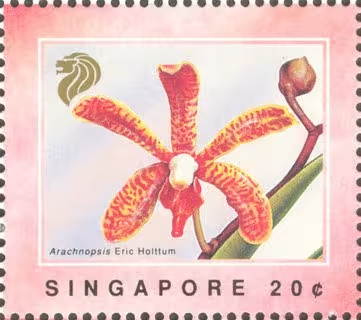
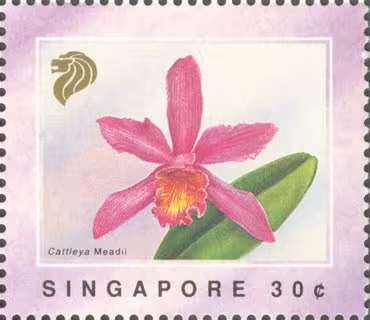
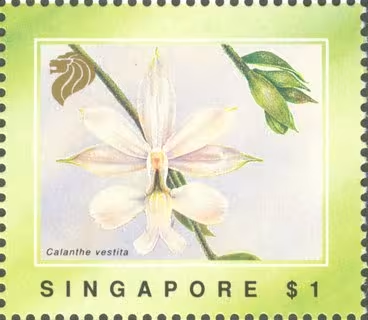
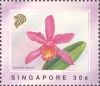
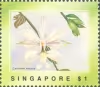
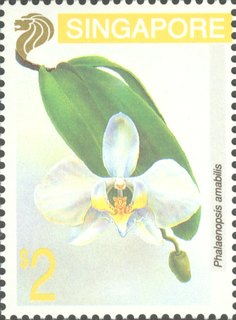
The Orchids special stamp issue is released to promote the Singapore Dress, the National Trade Union's gift to Singapore for the silver jubilee celebrations in 1990. The issue comprises three stamps depicting the Arachnopsis Eric Holttum, Cattleya Meadii and Calanthe vestita. Each orchid has a refreshing look. In line with the objective of promoting the Singapore Dress, the artist, Chua Ban Har, created her own orchid motifs for the first day covers, presentation packs and posters. Pastel shades complementing the colours of the stamps form the background colour.
A new collectible will also be launched with this issue - maxicards. Collectors will have a choice of two cards depicting two views of the Cattleya Meadii. The obverse of each card shows the flower against a light background. The right side of the card has space for affixing the 30 cent Cattleya Meadii stamp and for addressing. The reverse of the card is clear except for the words "Produced by Singapore Philatelic Bureau" and the national symbol. The clear space provides more writing space than the usual pictorial postcards.
The Orchids cards are sold for 30 cents each without any stamp affixed. Collectors can also buy these cards complete with a Cattleya Meadii stamp postmarked with the first day of issue datestamp, for 80 cents each. The charming pre-cancelled maxicards are good souvenirs for friends who visit Singapore or those wanting to start a collection. With their matching picture, stamp and postmark, collecting will indeed be an art.