Overview
Brunei Darussalam and Singapore have excellent relations and a strong historical bond. As small countries, we share many common perspectives. Bilaterally and in ASEAN, we co-operate extensively in a wide range of areas including defence, finance, trade, investment, tourism, health and education to promote our common interests. For instance, our Armed Forces train together, while our teachers and students benefit from school twinning programmes and cultural exchanges. Bilateral trade has grown steadily over the years, and there is a regular exchange of visits between our leaders, ministers and officials.
An enduring symbol of the close friendship between both countries is the Currency Interchangeability Agreement (CIA) which took effect on 12 June 1967. Under the CIA, each country undertakes to accept the currency issued by the other, and to exchange it at par and without charge, into its own currency. Forty five years on, the CIA has not only served its intended purpose, but continues to play an important role in facilitating trade, investment and tourism, and in integrating the two economies. Brunei Darussalam and Singapore remain fully committed to this long-standing Agreement.
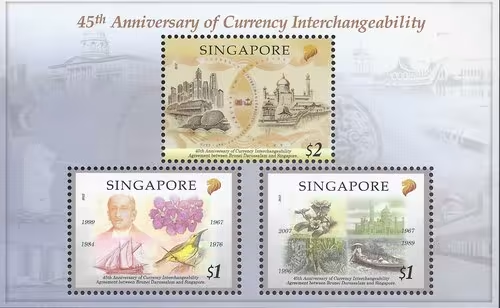
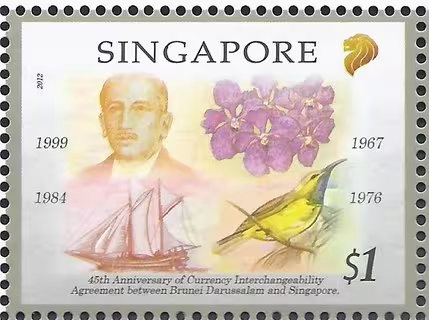
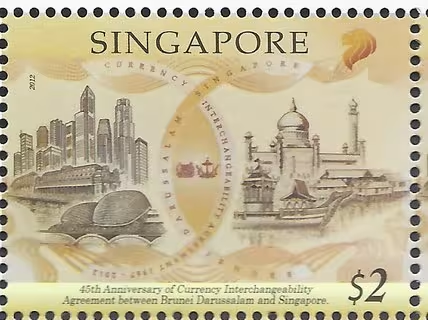
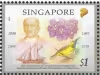
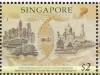
This cover issue comprises a set of 2 stamps - the first depicts iconic elements from past and present Singapore currency notes to showcase the evolution of our currency. To date, four series of currency notes have been issued, namely: the "Orchid" series (1967-1976), the "Bird" series (1976-1984), the "Ship" series (1984-1999) and the "Portrait" series (1999-present). The second stamp features the back of the 40th CIA anniversary commemorative note to highlight the milestones achieved in the CIA. Singapore and Brunei Darussalam jointly issued a commemorative note in June 2007 to mark the 40th anniversary of the agreement. The designs from Brunei Darussalam showcased the features the illustration of Omar 'Ali Saifuddien Mosque (1967), the view of Padian, the water village woman vendor in her boat (1989), the illustration of the view of a Rainforest Floor (1996) and the Ipomoea Pes-capre (Tapak kuda laut), a medicinal plant (2007).