Overview
Bridges are erected since time immemorial for use as passageways by people, animals, vehicles, etc. In Singapore, they form an important and integral part of the Republic's extensive communication network. Four of the most well-used bridges in Singapore are now depicted in a set of four special postage stamps to be released for sale on 15 March 1985.
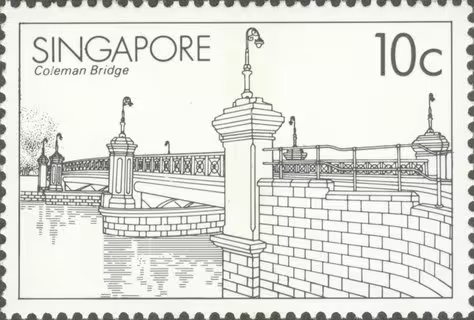
Appearing on the 10¢ stamp is the Coleman Bridge. Named after Singapore's first architect, G.D. Coleman, the bridge links New Bridge Road and Hill Street. It was first constructed in 1840, reconstructed in timber in 1865 and replaced by the present steel plate girder structure in 1883. This bridge has three clear spans of approximately 11 metres, 23 metres and 11 metres respectively across the Singapore River, and has a deck width of about 14.5 metres.
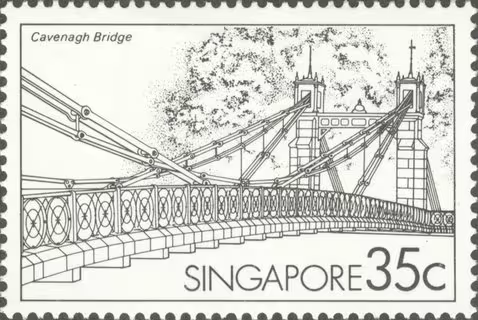
The elegant Cavenagh Bridge as shown on the 35¢ stamp is named after Governor William Orfeur Cavenagh, a strong supporter of Collyer Quay's construction. The bridge strides about 61 metres long and 10 metres wide across the section of Singapore River between Empress Place and Fullerton Square. With its completion in circa 1869, there was no need to ferry people across this part of the river any more. With the completion of the neighbouring Anderson Bridge in 1910, Cavenagh Bridge now serves as a footbridge closed to any vehicle with a laden weight exceeding 136 kilograms.
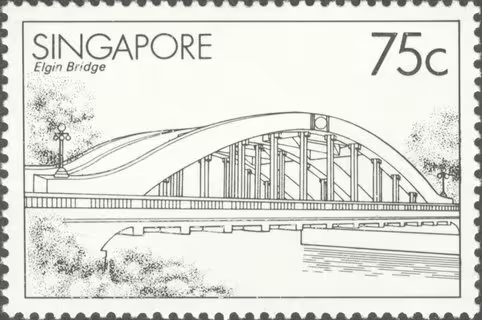
In 1822, a timber bridge known as Elgin Bridge was built over the Singapore River to link North Bridge Road and South Bridge Road. This bridge is named after Lord Elgin, Governor General of India. It was reconstructed into a draw bridge in 1844 and then converted into a steel one in 1863 before taking on its present form of three reinforced concrete bowstring arches in 1929. This graceful bridge which is approximately 43 metres long and 24 metres wide, is depicted on the 75¢ stamp.
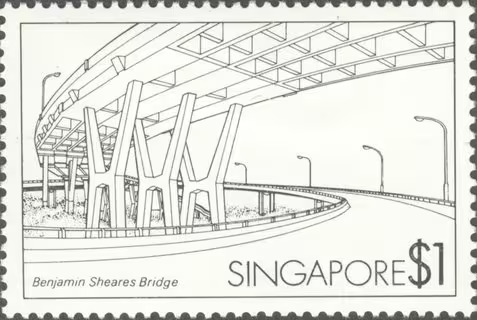
The breath-taking Benjamin Sheares Bridge on the $1 stamp forms a part of the expressway leading from the Changi International Airport to the city and ultimately to the western part of Singapore. The bridge, which was completed in 1981, is named after the late Dr Benjamin Henry Sheares, the Republic's second president. With a length of 1755 metres, the Benjamin Sheares Bridge is the longest bridge in Singapore. A unique feature of this bridge is the stylised H trestles between the conventional piers at the abutments, which form an aesthetically pleasing structure, blending well with the environment.