Overview
The beauty and grandeur of four monuments - Thian Hock Keng Temple, Hajjah Fatimah Mosque, Sri Mariamman Temple and the Armenian Church - were captured in this set of stamps issued in 1978. These monuments and their postage values are as follows:
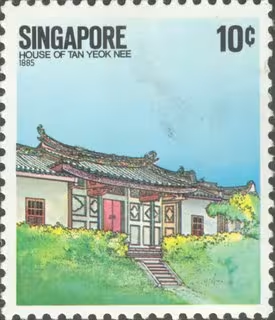
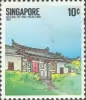
House of Tan Yeok Nee (10¢)
This House, now the headquarters of the Salvation Army, was built around 1885 for a prominent Teochew gambier and pepper merchant, Tan Yeok Nee (1827-1902). It has an architectural style common in southern China at that time. The family house was abandoned at the turn of the twentieth century when the first railway line passing along Tank Road (now Clemenceau Avenue) and up Penang Road was laid. It was subsequently occupied by the station master. In 1912, it was handed over in trust to the Anglican bishop and became St Mary's Home and School for Girls. In 1940, the Salvation Army bought over the house and has it ever since as its headquarters.
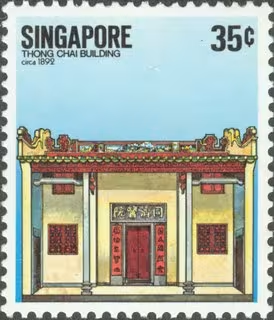
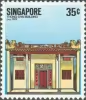
Thong Chai Building (35¢)
The Thong Chai Medical Institution Building was established in 1867 as a hospital where free medical care and treatment was made available not only to the early Chinese settlers in Singapore, but also to all other ethnic groups. Its present building at Wayang Street is believed to be completed in circa 1892. The Preservation of Monuments Board became the owner of the Building in 1972. Extensive restoration work was recently carried out at a cost of $350,000. The building is now leased out as an Arts and Crafts Centre.
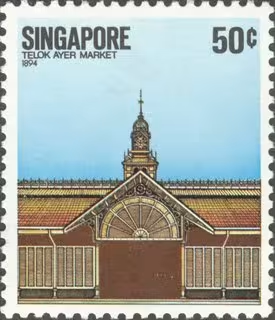
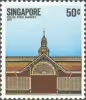
Telok Ayer Market (50¢)
In 1822, Sir Stamford Raffles ordered that the Municipal Market at the south end of Market Street and Guthrie Lane be rebuilt "as a measure of policy and for the general convenience and cleanliness of the place". Accordingly, a new octagonal market was completed in 1825. The market gradually became quite inadequate, and it was replaced by the present market which was erected in 1894 on land reclaimed in 1880. Also octagonal in shape, this market popularly known as the Telok Ayer Market or Old Market, is typically Victorian with an elaborate cast-iron frame. The building was given a face lift by the Government in 1970 and in 1973 when it was converted into a cooked food centre known as the Telok Ayer Food Centre.
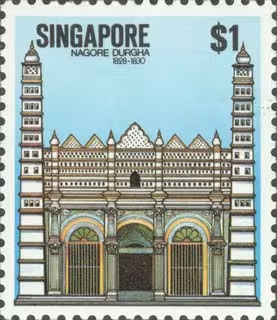
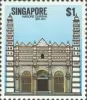
Nagore Durgha ($1)
The shrine, originally known as Shahul Hamid Durgha, was built by Southern Indian Muslims in 1828-30. The land for the shrine was granted to a certain Kaderpillai in 1827, with the provision that it was not to be used for a building of wood and attap. The result is a building that is unique and interesting - combining the architectural styles of the East and West.